
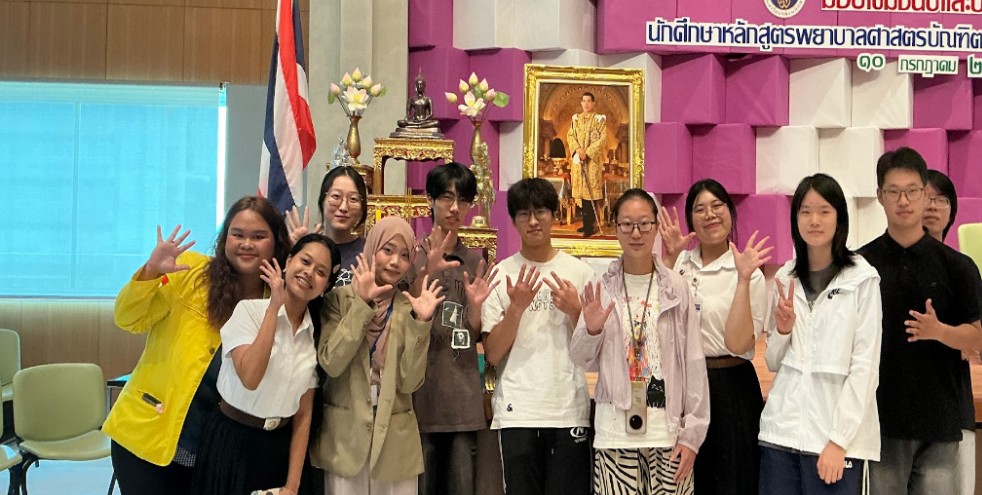

The plane had barely touched down in Bangkok when it hit me: for the next two weeks, “home” would look completely different. I didn’t know who would be waiting at the airport, or how much this trip would change the way I see nursing. All I knew was that I was one of three nursing students from PSIK UGM chosen for a mobility program at Mahidol University, Thailand. Held from 13 to 24 July 2026 under the theme Cultural Diversity in Health Care for Interprofessional Education, it sounded like just another academic exchange. It turned out to be so much more. I half expected Thailand to feel foreign. Instead, it felt familiar: the warm weather, the buzz of the streets, and above all the kind, hospitable people. That warmth carried into Mahidol’s classrooms, where lecturers engaged with every international student, welcomed different viewpoints, and turned a room of strangers into a shared space for learning.
Our first week centered on lectures that were broad yet remarkably applicable to real life. But the moments that stayed with me happened outside the classroom. Learning about Buddhism at a local place of worship showed me how deeply religion shapes daily life and, in turn, how patients understand health and healing. At Samut Sakhon Hospital, a referral hospital serving migrant communities, we saw what it takes to deliver care across language and cultural barriers. A visit to a school for Myanmar migrant children quietly reframed how I think about access to healthcare, education, and dignity. The Mahidol University Anatomy Museum then tied it all back to the fundamentals of our field. Together, these visits made one thing clear: healthcare looks different depending on who you care for, and understanding a person’s culture matters as much as understanding their diagnosis.
None of this would have meant as much without the people. Three Mahidol students, Thip, MK, and Nord, were waiting at the airport, and what began as a quiet car ride became hours of conversation that set the tone for the whole program: open, curious, and full of exchange. We also spent time with students from PMCU and from universities in China and Hong Kong, including graduate students whose sharper questions and broader perspectives taught me as much as the lectures did. A highlight was the cultural activity day, with Thai songs, traditional dances, local food, and even arranging flower bouquets for religious offerings. It reminded me that culture is best learned not by reading about it, but by taking part in it.
Being placed in a group without my two UGM classmates forced me to rely on myself. I introduced myself to strangers, communicated entirely in English, and navigated new group dynamics. It wasn’t always comfortable, but it made me grow, and by the end, starting a conversation felt far less daunting than on day one. This experience reshaped what I think makes a good nurse. I saw how vital communication is, even when language gets in the way; how cultural sensitivity directly determines whether a patient feels safe and understood; and how healthcare is a collaborative effort reaching far beyond any one profession or country. Before Mahidol, I saw international mobility mainly as studying in a new academic setting. Now I see it as a chance to know myself better, communicate across cultures, and view nursing through a wider lens. I’m bringing home more patience, more curiosity, and a clearer picture of the nurse I want to become: one who leads with respect and cultural awareness. To future participants: don’t hold back. Say yes to every conversation, visit, and cultural activity, and be brave enough to leave your comfort zone, because two weeks pass faster than you think. I arrived expecting a summer course. I left with new perspectives, meaningful friendships, and a deeper understanding of what it means to learn beyond borders.
Thailand, July 13th-24th, 2026
Putri Eka Desintha